

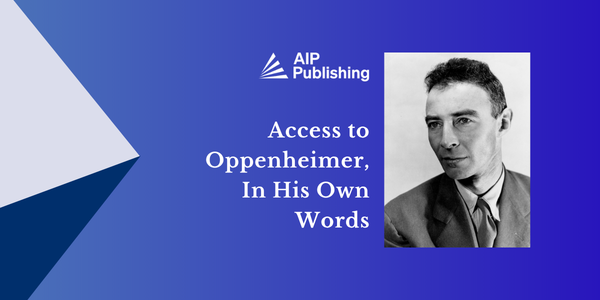
Access to Oppenheimer, In His Own Words
Intoduction
For many years, AIP’s Niels Bohr Library & Archives has kept three oral history interviews with J. Robert Oppenheimer within its Oral History Collections. At the time the NBLA acquired them, archival standards were more restrictive and predated the digital tools that now facilitate researcher access. An informal and somewhat vague governance policy from that period has required ongoing communication between NBLA staff and the Oppenheimer family to manage individual access and usage permissions for these remarkable interviews. This outdated approach has greatly limited their discovery by the history of science community.
Through a shared dedication to fostering research, access, and education in the history of science, AIP’s Niels Bohr Library & Archives and the Oppenheimer family have collaborated to update and clarify the permissions and usage agreements governing these interviews. We are pleased to announce that these three vital oral histories are now available for public research access and non-commercial use through AIP’s online repository.
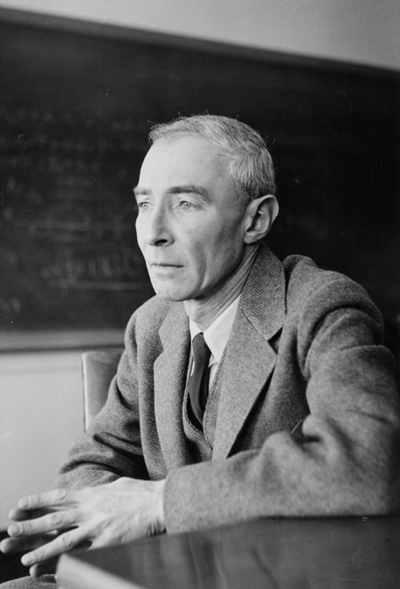
American Institute of Physics and Niels Bohr Library & Archives with J. Robert Oppenheimer
“The Oppenheimer family is happy to work with the Niels Bohr Library & Archives to release its archival record of J. Robert Oppenheimer recordings and transcripts to the public for non-profit research and education. The Archive’s mission of increasing access to and promoting research of the history of science aligns with the family’s interest in making Oppenheimer’s historical role in science more broadly accessible by presenting Oppenheimer’s thoughts and recollections from his own perspective.”
– Statement from the Oppenheimer family
In serving the physical sciences community and working to preserve its history, the American Institute of Physics and Niels Bohr Library & Archives has maintained a long-standing relationship with J. Robert Oppenheimer, both during his lifetime and later with members of his family. Oppenheimer offered crucial early support for AIP’s NBLA, speaking at the library’s opening in 1962 where he underscored his belief in the importance of its mission to preserve and share the history of the physical sciences.
Reflections on the Resonances of Physics History: Talk Presented at the Dedication Ceremony of AIP’s Niels Bohr Library
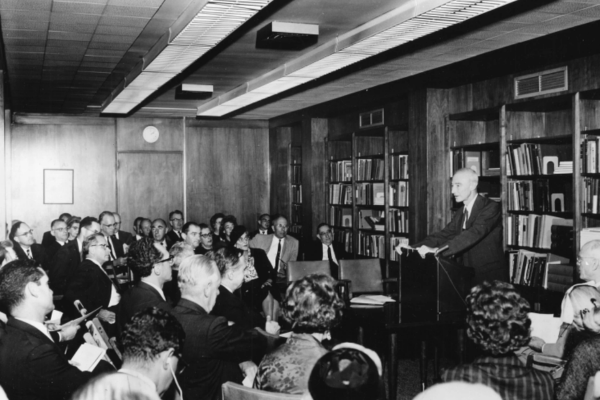
“We are so engulfed by the changes, the massiveness, the ferocity, the brashness, the virtuosity, the confusion of the current scene in physics, that we do not understand it very well, and it may not be possible for us to understand it. The enterprises which are now underway, and for which this room will serve as hearth, should make it possible, if there are serious students of the human predicament in the future, to know very much more about what has befallen us than we who are acting and living in it. And they will see both good and bad things, and they will see them in a wiser and deeper perspective than we who act in it.”
– Oppenheimer
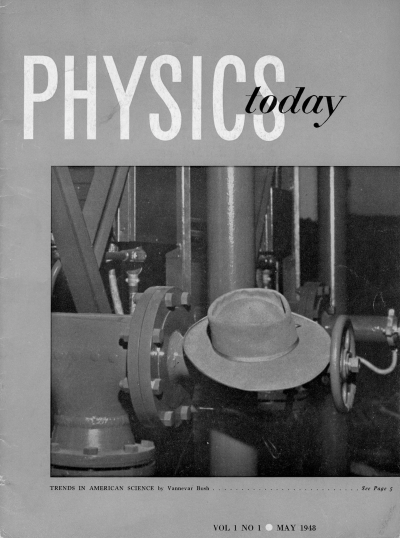
The bond between Oppenheimer and AIP’s mission of advancing the physical sciences was further demonstrated by the selection of a photo of Oppenheimer’s signature porkpie hat as the cover image for the very first issue of Physics Today in 1948.
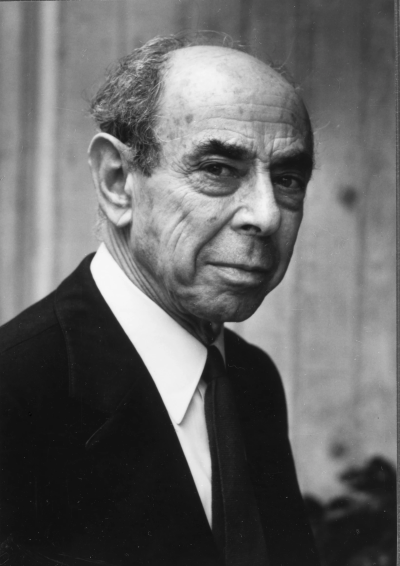
His brother, Frank Oppenheimer, also a physicist, took part in an oral history interview with AIP’s History program in 1973, where he discussed his own personal life, political and scientific work, and efforts to promote science education. This interview, conducted over two sessions, was added to the NBLA’s Oral History Collection, one of the institution’s most valuable and heavily used collections of unique historical narratives of 20th- and 21st-century science.
The newly opened J. Robert Oppenheimer interviews will now be accessible for research in the AIP digital repository, alongside his brother’s interview and those of many others whose stories intertwine to form the history of 20th-century science.
The newly accessible interviews with J. Robert Oppenheimer were carried out in 1960, 1963, and 1966 by three different interviewers with three very distinct purposes, each shedding light on a wide range of fundamental aspects of Oppenheimer’s life, his work, the influences that shaped his experiences, and his viewpoint on his role in the broader history of physics. The origin of each interview also presents fascinating narratives of how materials come to be part of AIP’s collections and illuminates essential context for the conversations that prompted Oppenheimer’s thoughts and recollections.
1960
The earliest interview in NBLA’s collection was not conducted by AIP’s oral history program but rather is a transcript of a recorded conversation with Oppenheimer by journalist Robert Cahn in February 1960. At the time, Cahn was writing an article on the development of the first atomic bomb and events of the Trinity Test as a freelancer for the Saturday Evening Post. In the transcript, Oppenheimer provides an account of the period surrounding the Trinity Test and reflects on the infamous events.
“But this was the beginning of a new age for man. The problems that have bedeviled him in the past were not going to stop bedeviling him. That this was a new one which would alter the light in which they were looked on was the true sense of what we breathed that morning after the first test.”
– Oppenheimer
Cahn’s article, “Behind the First A-Bomb,” was published in the July 16, 1960 issue of The Saturday Evening Post. Interestingly, Cahn did not use direct quotes from his personal interview, nor acknowledge his firsthand source of the details enriching his story. The article’s detailed, narrative-style retelling of the events surrounding the detonation of the first atomic bomb highlighted a continued, popular fascination with Oppenheimer and the transformative events of the Manhattan Project that shaped politics, society, and science in the following decades.
Eventually, Cahn taught courses at the University of Colorado at Boulder, where he presumably provided the transcript of the Oppenheimer interview to the renowned physicist Dr. Albert Allen Bartlett, a professor in the CU Boulder Department of Physics and veteran of the Manhattan Project. As President of the American Association of Physics Teachers (1978) and a Fellow of the American Physical Society, Bartlett had many connections with AIP and significant knowledge of its library and history programs. Over time, he donated to the NBLA a variety of historically significant material, including a set of papers concerning the unsuccessful nomination of J. Robert Oppenheimer, Edward U. Condon, and George Gamow for the 1967 Nobel Prize in Physics. Ultimately, it was through Bartlett that the transcript of Cahn’s interview with Oppenheimer reached the NBLA, although the audio tape was not included in the deposit and may have stayed with Cahn.
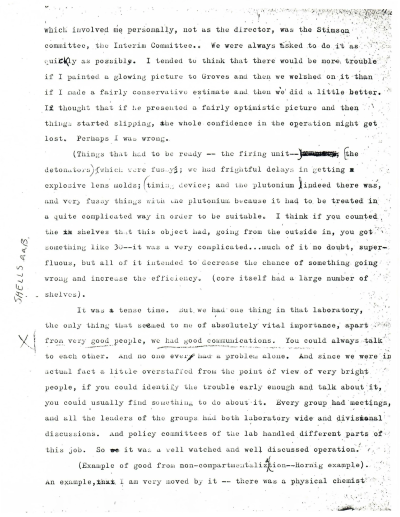
Several questions regarding the transcription of the original audio remain mysterious in the story of the material’s origin. It is unclear whether Cahn transcribed the tape (or hired a transcriber) after he conducted the interview in 1960, or whether Bartlett transcribed it from Cahn’s lent audio tapes. Furthermore, there are numerous handwritten marks and corrections in the document that may have been added by Cahn, Bartlett, contributed by both men, or marked by a third party. Some marginalia do appear to be signed “AbB,” which would indicate Bartlett’s interventions.
1963
While Cahn’s 1960 interview drew out information relevant to popular interest in the Manhattan Project, the 1963 interview in NBLA’s collection was conducted by historian Thomas S. Kuhn to capture essential details of Oppenheimer’s life in his own words for the historical record. Recorded over two days on November 18 and 20, 1963, the tapes and subsequent transcript, approximately 60 pages, were archived with AIP as part of its involvement in a broader initiative to document the history of quantum physics through the international, multi-institutional “Archive for the History of Quantum Physics” project. Its inclusion in the AHQP catalog and the detailed perspective provided by Oppenheimer of his early life, his education, and participation in the exciting development of quantum physics in Europe and the United States have made this interview an essential primary source and resulted in frequent requests for access and use by researchers.
Notably, the interview was directly quoted multiple times by Kai Bird and Martin J. Sherwin in their Pulitzer Prize-winning biography of Oppenheimer, American Prometheus: The Triumph and Tragedy of J. Robert Oppenheimer, which served as a basis for the 2023 blockbuster film Oppenheimer.
“Upon arriving in Zurich, Wolfgang Pauli told him about his own work with Heisenberg. By then, Robert was very much interested in what he called the “electron problem and relativistic theory.” That spring he nearly collaborated on a paper with Pauli and Heisenberg. “At first [we] thought the three of us should publish together; then Pauli thought he might publish it with me, and then it seemed better to make some reference to it in their paper and let [my paper] be a separate publication. But Pauli said, ‘You really made a terrible mess of the continuous spectra and you have a duty to clean it up, and besides, if you clean it up, you may please the astronomers.’ So that’s how I got into that.” Robert’s paper was published the following year under the title “Notes on the Theory of Interaction of Field and Matter.””
– Direct quotes of the 1963 interview published in American Prometheus (p. 75)
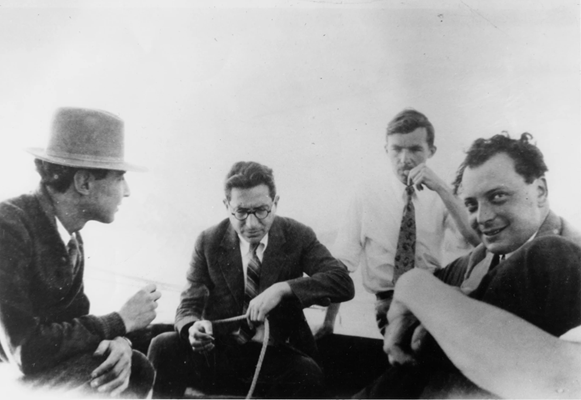
Previously, such use in a book would have required extensive effort on behalf of the researcher to formally submit multiple requests for access and then request additional permission for use. However, the newly established agreement makes such vital records directly available for research online and streamlines their non-commercial use.
The AHQP project collected a vast array of such valuable materials from key figures including Niels Bohr, Erwin Schrödinger, Max Born, and Maria Goeppert Mayer, among many others.
1966
The final Oppenheimer interview in AIP’s collections was conducted not primarily to record Oppenheimer’s life but to understand his thoughts and perspectives on his Manhattan Project colleague, Enrico Fermi. Under the auspices of Harvard Project Physics, a national science education reform initiative begun in 1962 to develop and establish a high school physics curriculum, the interview was carried out as a piece for the educational documentary film, The World of Enrico Fermi (1970).
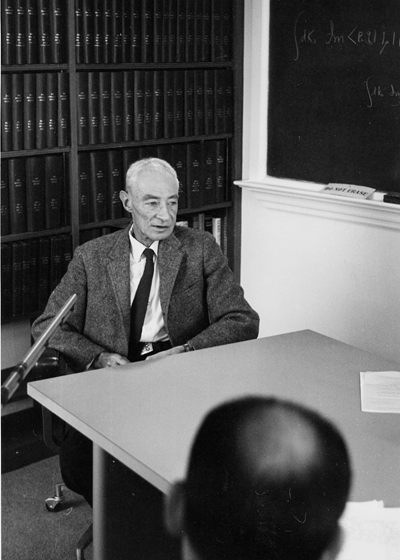
Interviewed on November 1, 1966 by Charles Weiner, director of AIP’s Center for the History of Physics, Oppenheimer offered his personal and professional impressions of Enrico Fermi and Fermi’s impact on physics.
“His impact during his lifetime was very great; in the professional community, among physicists, he was deeply loved, imitated, as far as it lay in people’s power to do so, by very many. He changed the style in which a whole set of problems were thought about and the language that was used.”
– Oppenheimer
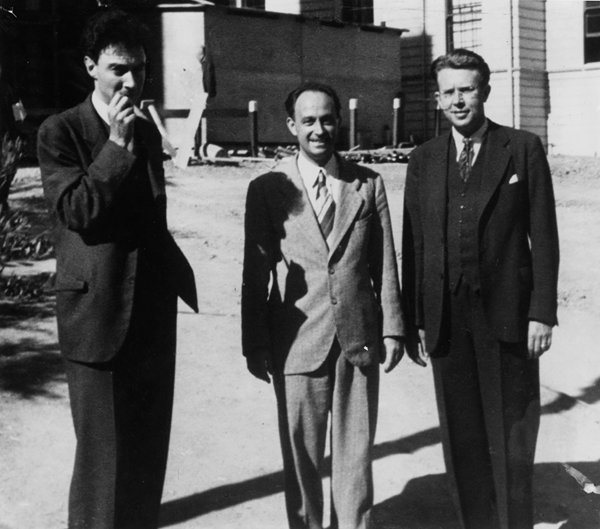
He further described Fermi’s role in atomic research, including the importance of Fermi’s later contributions in areas such as meson physics and the development of Fermi’s theory of beta decay. He additionally reflected on the migration of European scientists, such as Fermi, to the U.S. in the 1930s and the role they played in closing the gap between European and American physics.
The World of Enrico Fermi (1970)
At the end of the interview, Oppenheimer considered the differences between the physics community of the early 20th century and that of the 1960s.
“Of course, physics is an enormous subject, and I inevitably think about the part of it which of all has the greatest interest for me, and that is the laws of matter. We are obviously in motion, and there is an upward component to the motion. It spirals. It’s confused. But we know more each year, and the things we know are not things that we supposed we would know. They are really rather new and fresh, and they correspond with increased ability to describe and within limits to predict. So I think it’s a wonderful period. But most people half my age say they’re too old to enjoy it.”
– Oppenheimer
Four months after the 1966 interview was recorded, Robert Oppenheimer passed away due to throat cancer on February 18, 1967. His complex legacy as the leader of the Manhattan Project and the scientist who established the United States as a worldwide center of quantum physics places him as an essential figure in the history of modern science. While his contributions can be traced through many archival sources, increased research access to these interviews ensures that we may also gain a better understanding of Oppenheimer in his own words.
In American Prometheus, Kai Bird emphasizes the importance of accessing such personal, historical accounts in describing his approach to writing the biography, “a person’s public behavior and his policy decisions (and in Oppenheimer’s case perhaps even his science) are guided by the private experiences of a lifetime.”
Copyright 2026 American Institute of Physics. All Rights Reserved.