

New light-based chip boosts power efficiency of AI tasks 100 fold
Introduction
Artificial intelligence (AI) systems are becoming increasingly central to modern technology, supporting applications ranging from facial recognition to language translation. However, as AI models grow more complex, their electricity consumption rises significantly—creating challenges for energy efficiency and sustainability. A new chip developed by researchers at the University of Florida offers a potential solution by using light in addition to electricity to perform one of the most power-intensive tasks in AI. Their findings are published in Advanced Photonics.
Technical Innovation: Light-Based Convolution Processing
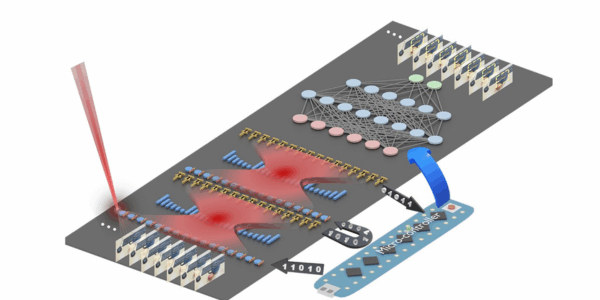
The chip is engineered to execute convolution operations, a fundamental process in machine learning that allows AI systems to identify patterns in images, video, and text. These operations typically demand substantial computational resources. By embedding optical components directly into a silicon chip, the research team has developed a system that uses laser light and microscopic lenses to carry out convolutions—significantly lowering energy use while accelerating processing speed.
“Completing a core machine learning computation with nearly zero energy represents a major advancement for the future of AI systems,” explained study lead Volker J. Sorger, the Rhines Endowed Professor in Semiconductor Photonics at the University of Florida. “This progress is essential to support the continued expansion of AI capabilities in the coming years.”
During testing, the prototype chip achieved approximately 98 percent accuracy in classifying handwritten digits—performance on par with conventional electronic chips. The system incorporates two arrays of miniature Fresnel lenses—flat, ultrathin lens designs similar to those used in lighthouses—which are fabricated using standard semiconductor manufacturing processes. These lenses, each thinner than a human hair, are etched directly onto the chip surface.
To conduct a convolution, machine learning data is first encoded into laser light on the chip. The light then passes through the Fresnel lenses, which perform the required mathematical transformation. The resulting output is subsequently converted back into a digital signal, completing the AI task.
Research Breakthrough: First On-Chip Optical Neural Network
“This marks the first successful integration of this form of optical computation onto a chip and its application within an AI neural network,” stated Hangbo Yang, a research associate professor in Sorger’s group at the University of Florida and co-author of the study.
The team further showcased the chip’s ability to handle multiple data streams concurrently using a technique called wavelength multiplexing, which employs lasers of different colors. “We can transmit multiple wavelengths, or colors, of light through the lens simultaneously,” Yang explained. “This parallelism is a fundamental advantage of photonic systems.”
The research was carried out in partnership with the Florida Semiconductor Institute, UCLA, and George Washington University. Sorger highlighted that chip manufacturers like NVIDIA are already incorporating optical components in certain aspects of their AI systems, a factor that could facilitate the adoption of this new technology.
Conclusion: Toward Sustainable AI Computing
“In the near future, chip-integrated photonics will become an essential component of the AI chips we use every day,” Sorger predicted. “Optical AI computing is the next frontier.”
Copyright 2025 SPIE. All Rights Reserved.
Contact us via email for more information.